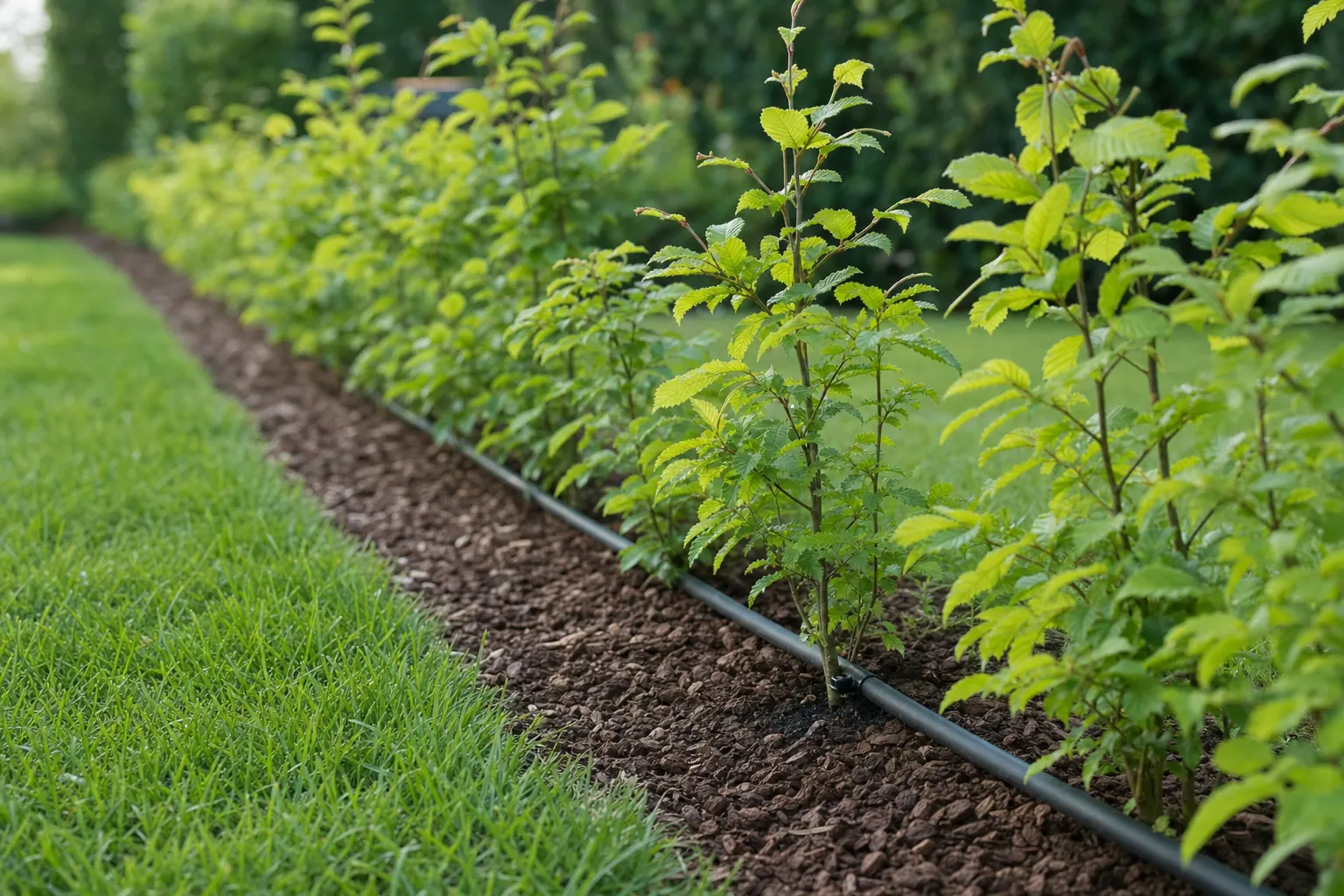
The run time in two steps
1. The watering rate
The line or its packaging states how many litres a dripper gives per hour, usually 1 to 4 litres, and how far apart the drippers sit. Add the distance between two lines. If only one line runs along the hedge, use the width of the strip it supplies instead.
Watering rate in mm/h = litres per dripper and hour ÷ (dripper spacing × line spacing, both in metres)
This works because 1 litre on 1 square metre makes 1 mm of water depth. Dripper spacing times line spacing is the area one dripper supplies.
2. The minutes
Minutes = need in mm ÷ watering rate in mm/h × 60
What your plants are missing per day you work out as described in the guide on water needs. If you do not water every day, add up the need of the days since the last watering.
A worked example for a hedge
The values in the box are example values.
Example values
- 2 litres per dripper and hour
- Dripper spacing 40 cm
- one line supplying a strip 50 cm wide
- Daily need 4 mm
Calculation
- One dripper supplies 0.4 m × 0.5 m = 0.2 m².
- 2 l/h ÷ 0.2 m² = 10 l/m² per hour, so 10 mm per hour.
- 4 mm ÷ 10 mm/h × 60 = 24 minutes.
2 l/h on 0.2 m² = 10 mm per hour
Along 10 m of hedge there are 25 drippers with 50 l/h together. In 24 minutes they deliver 20 litres onto 5 m² of strip, so 4 litres per square metre. The length changes the litres, the minutes stay the same. If you water only every three days, you calculate with 12 mm and arrive at 72 minutes.
Why a drip line runs longer than a sprinkler
A dripper gives only a few litres per hour, and at one spot. Drip irrigation therefore delivers water much more slowly than a sprinkler. That is intended. The soil has time to take up the water, and as a rule nothing runs off the surface. Slow still does not mean as long as you like. Colorado State University advises against running a drip line overnight just because it drips slowly.
With or without pressure compensation
Pressure-compensating drippers give the same amount over a wide range of pressure, at the start of the line as at its end. Then the litre figure on the line applies to every dripper, and the calculation holds along the whole length. According to the Bavarian Garden Academy, lines without pressure compensation suit level ground and short runs. For longer lines it recommends pressure-compensating ones. On a slope or on long lines without compensation, check with the spade at the end of the line.
Sand, loam and long run times
On sand the water seeps down quickly, and the soil holds little of it. In loam and clay it spreads more to the side, but the soil takes it up more slowly. If more arrives there than it takes up, water stands on the surface.
So split long run times into several waterings with breaks in between. The Bavarian Garden Academy, for example, spreads 20 litres per square metre over three to four portions in a good three hours. According to it, a soil in summer takes up no more than 20 to 25 litres per square metre at once, and the rest seeps deeper, down to the groundwater. On sand, shorter and more frequent waterings help keep the water in the root zone.
Check with a spade
The soil shows whether the run time is right. One to two hours after watering, dig a hole next to a dripper or pull a core with a soil probe. Moist soil is darker than dry soil. According to the Rhineland-Palatinate Garden Academy, the soil should be well moistened 15 to 20 cm deep after watering. Also check midway between two drippers, because a drip line only moistens part of the soil.
If the soil at the roots stays dry, lengthen the run time. If it is wet far below them, shorten it. The Bavarian Garden Academy sees too much water at many automatic drip systems.
Young hedge, established hedge
According to the Bavarian Garden Academy, extra water is needed mainly by newly planted woody plants in their first 2 to 5 years and by water-loving species such as thuja. Water newly planted thujas thoroughly one to three times a week, depending on soil and weather.
Established woody plants usually root wide and deep and need watering only in individual cases. A thuja hedge that has taken root only needs water in summer during longer dry spells, then thoroughly with at least 10 litres per square metre per watering. With the line from the example that is at least 60 minutes.
What Tropfwerk calculates
Tropfwerk works this out for every zone itself. For a drip zone the drip line figures are enough, that is length, dripper spacing and litres per dripper, which give the zone’s flow. Tropfwerk determines every day from the weather data with FAO-56 how much water the soil is missing and tops up that amount before sunrise. On loam and slopes it waters in rounds with Cycle & Soak and leaves time to soak in between. Because Tropfwerk calculates drip zones with the figures from the line, a pressure-compensating line pays off there.