Often at first, then less often and deeper
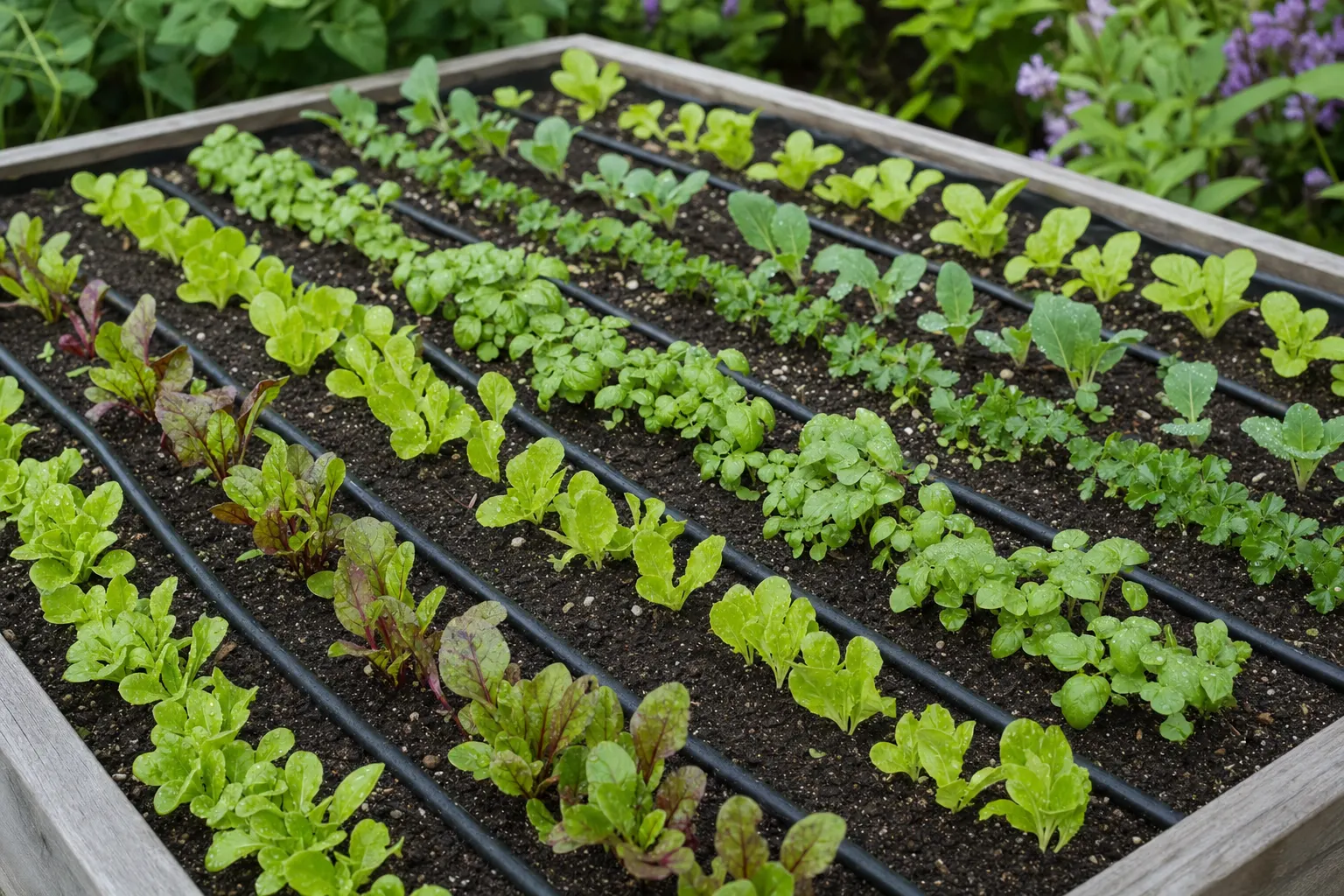
A young plant can only use the water its roots already reach. Lawn seedlings do not yet have a full root system, and the roots of freshly planted woody plants stay in the planting hole for weeks. The shallower the roots, the smaller the supply. In the heat a lawn can then show drought damage after just one or two days.
At first you therefore water more often, and each time enough for the water to reach the roots. As soon as they take hold, lengthen the intervals and give more each time, so that the roots grow deep. If you keep watering often and little, you get a shallow root system that suffers quickly in a drought.
- New turf
- 15 litres per square metre right after laying
- Keep moist, in summer even several times a day
- After 2 to 3 weeks less often and more each time
- New seed
- For 3 weeks every 1 to 2 days, 5 to 10 litres per square metre each
- Then once or twice a week, 10 to 15 litres per square metre each
- Shrubs and trees
- For 1 to 2 weeks daily
- Until week 12 every 2 to 3 days
- Then weekly
- Thoroughly every time, at least 10 litres per square metre
Watering new turf
Right after laying and rolling, turf gets a generous watering; the Bavarian Garden Academy gives 15 litres per square metre (l/m²). Until the rolls have rooted, they and 3 to 5 cm of soil below them should stay moist, which in summer can mean water several times a day. If a roll dries out even once in the first days, lasting damage is to be expected, according to the German Lawn Society. In cool or wet weather it needs less water or none. So that the outer edges do not dry out, they are banked up with soil.
After about two to three weeks turf has usually rooted and may be walked on. To check, lift a roll at one corner. If it holds, lengthen the intervals and give more water each time. How to carry on is in How much water does your lawn need?
Keeping new seed moist
As soon as the seeds have been soaked once and germinate, the top layer of soil has to stay moist all the time, or the seedlings dry out. For the first three weeks the Bavarian Garden Academy gives 5 to 10 l/m² every one to two days, after that 10 to 15 l/m² once or twice a week. In dry and hot weather it advises a short spray several times a day, the German Lawn Society four to five times a day for about ten minutes. Use a sprinkler with fine nozzles so that the soil does not silt up.
Watering in hedges, shrubs and trees
The planting hole should be one and a half to two times the size of the root ball; for a hedge you dig a trench twice as wide and deep as the root ball. After planting, water once generously so that the soil closes around the roots, and do not tread it down afterwards. A watering ring of soil keeps the water above the roots.
For a freshly planted thuja hedge the Bavarian Garden Academy gives one to three thorough waterings a week, depending on soil and weather, and after rooting only in longer dry spells. Pennsylvania State University advises watering trees and shrubs daily in the first one to two weeks, every two to three days until week twelve, then weekly. Each time, water enough to soak the soil, according to the Garden Academy at least 10 l/m².
A woody plant has taken root when its roots have grown into the surrounding soil and it grows evenly year by year. The Bavarian Garden Academy advises watering a tree in its first three to four years in the ground, less often after that.
Heat and wind
According to the Bavarian Garden Academy, a lawn uses about 2 to 3 l/m² a day at a daily high of 20 to 25 °C, and 4 to 7 l/m² at 30 to 35 °C. Wind dries things out as well, according to the North Rhine-Westphalia Chamber of Agriculture even under a cloudy sky and in moderate warmth. Young plants need water sooner on such days. Water in the morning, when the least evaporates and there is hardly any wind. More in Water in the morning or in the evening?
Too much water does harm too
If water stands in the root zone, the roots lack oxygen. They rot and no longer take up nutrients. Signs are soil that is always wet and young leaves turning light green or yellow. So loosen the bottom of the planting hole so that surplus water drains away, and before a big watering check with the spade whether the soil is still moist 20 cm down. A soil takes up no more than 8 to 10 l/m² an hour, so spread larger amounts over several rounds.
Establishment watering with Tropfwerk
Under “Set up establishment watering” the zone with the young plants gets an establishment watering. You decide how long it runs, and on its last day it ends by itself. After measured rain it pauses with the rain pause. For an extra watering, for example right after planting, there is “Run establishment now”.
After that Tropfwerk calculates the zone every night with FAO-56 again and tops up the water the soil is missing before sunrise.